SIGGRAPH 2011 Emerging Technologies Preview
 Print This Post
 The SIGGRAPH Emerging Technologies program is home to the latest developments in technology, including haptics, displays, robotics, and artificial intelligence. SIGGRAPH 2011 will feature 23 of the latest innovations selected by a jury of industry experts from more than 100 submissions, with topics ranging from displays and input devices to collaborative environments. SIGGRAPH 2011 takes place this August 7th through 11th at the Vancouver Convention Centre.
The SIGGRAPH Emerging Technologies program is unique in its interactive approach that allows people to experience the most cutting-edge developments first-hand,” said Cole Krumbholz, SIGGRAPH 2011 Emerging Technologies Chair and co-founder of Koduco Games. “This year, conference attendees will experience the latest achievements from industry and university research labs.”
[youtube:http://www.youtube.com/watch?v=KwGK6lGnu90]
Here is a sampling of the featured highlights from the SIGGRAPH 2011 Emerging Technologies; more can be viewed on the SIGGRAPH 2011 web site.
Face-to-Avatar
Hiroaki Tobita and Shigeaki Maruyama; Sony Computer Science Laboratories, Inc.
This floating avatar system integrates a blimp with a virtual avatar to create a unique system of telepresence. The blimp avatar contains several pieces of equipment, including a projector and a speaker as the output functions. Users communicate with others by presenting their facial images through the 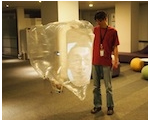 projector and voices through the speaker. A camera and microphone attached to the blimp provide the input function and support the user’s manipulation from a distance.
The user’s presence is more dramatic than a conventional virtual avatar (CG and image) because the avatar is a physical object and moves freely in the real world. In addition, the user’s senses are augmented because the blimp detects dynamic information in the real world. For example, the camera provides a special floating view to the user, and the microphone collects a wide variety of sounds such as conversations and environmental noise.
Potential Future Use: Allows the user to have a moveable, physical presence in the real world from even the most remote location.
Volumetric Display Based on Vibrating Mylar Beam Splitter and LED Backlit LCD
Lanny Smoot, Quinn Smithwick, and Daniel Reetz; Disney Research
This new volumetric display produces full-color, high-spatial-resolution aerial images in front of the apparatus. It is based on a new optical element: the large, tunable-resonance, edge-driven, varifocal beam splitter.
This new display technology uses a circular Mylar beam splitter and adds a tension-adjusting metal hoop 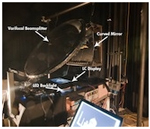 pressed against its surface. The beam splitter is adjusted, with high Q, to a specific resonance frequency. Three rim-mounted impulse drivers apply low-amplitude sinusoldal drive. Due to the high Q, the diaphram’s sympathetic vibration is large. The beam splitter folds the optical path, and the system includes a fixed-curvature concave mirror to create real images that appear out in front of the apparatus.
It produces high-quality 3D images that occupy a one-third-meter cube 1/3 meter out in front of the apparatus. The image is viewable over a 30-degree viewing angle.
Potential Future Use: Advancements in 3D displays will impact many fields from medical research to gaming.
A Medical Mirror for Non-Contact Health Monitoring
Ming-Zher Poh, Harvard-MIT Division of Health Sciences and Technology; Daniel McDuff and Rosalind Picard, MIT Media Lab
Digital medical devices promise to transform the future of medicine with their ability to produce exquisitely detailed individual physiological data. As ordinary people gain access to and control over their own physiological data, they can play a more active role in diagnosing and managing their health. This revolution must take place in our everyday lives, not just in the doctor’s office or research lab. This project starts in the home environment by transforming everyday objects into health-sensing technology.
The Medical Mirror is a novel interactive interface that tracks and displays a user’s heart rate in real time without the need for external sensors. Currently, collection of physiological information requires users to strap on bulky sensors, chest straps, or sticky electrodes. The Medical Mirror allows contact-free 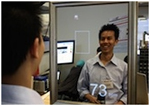 measurements of physiological information using a basic imaging device. When a user looks into the mirror, an image sensor detects and tracks the location of his or her face over time. By combining techniques in computer vision and advanced signal processing, the user’s heart rate is then computed from the optical signal reflected off the face. The user’s heart rate is displayed on the mirror, allowing visualization of both the user’s physical appearance and physiological state.
This project illustrates an innovative approach to pervasive health monitoring based on state-of-the-art technology. The Medical Mirror fits seamlessly into the ambient home environment, blending the data collection process into the course of daily routines. It is intended to provide a convenient way for people to track their daily health when they use the mirror for shaving, brushing teeth, etc.
Potential Future Use: This device allows for easy and much more sophisticated everyday health monitoring.
Telenoid: Tele-Presence Android for Communication
Kohei Ogawa, Shuichi Nishio, Kensuke Koda, Koichi Taura, Takashi Minato, Carlos Toshinori Ishii, Hiroshi Ishiguro; ATR Intelligent Robotics and Communication
This new system of telecommunication focuses on the idea of transferring human “presence”. A minimal human conveys the impression of human existence at first glance, but it doesn’t suggest anything about personal features such as gender or age. The minimal appearance allows people to use Telenoid to transfer their presence to distant places regardless of their personal features.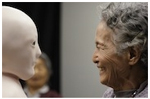
Telenoid’s tele-operation system is simple and intuitive. It can be controlled by even novice users. Its face-tracking system automatically captures the operator’s facial movements and expressions. Field tests revealed that most users tended to have a strange and negative impression of Telenoid in the beginning, but eventually they became comfortable. Elderly people had very positive feelings about Telenoid at first sight.
Potential Future Use: Telenoid provides a much more interactive and intimate experience than technology that is available today, such as Skype.
True 3D Display
Hidei Kimura and Akira Asano, Burton Inc.; Issei Fujishiro and Ayaka Nakatani; Keio University
This research team was the first to use laser-plasma technology for a true-3D display device that allows 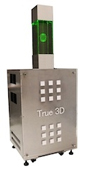 users to draw 3D images in midair. Now the team has developed a much more compact and precise display, called SRV (Super Real Vision)-5000, based on advanced laser technology. One remarkable feature of the new device is its enhanced resolution: from 300 points per second to 50,000 points per second. It displays 3D objects more faithfully in real time and increases the range of possible applications.
Potential Future Use: Advancements in 3D displays will impact many fields from medical research to gaming.